Game guide · Wargaming
World of Tanks explained: how the game actually works, and what it costs
Before you read on
This page contains partner links (affiliate links). If you create an account through a link marked “Partner link”, the publisher of this site may receive a commission from the advertiser. The games discussed here are free to download and play, and using our links never changes what you pay.
Commission does not buy a good write-up. Nothing on this page is a review score, a testimonial, or a claim of a guaranteed result, and the drawbacks are listed alongside the strengths. Read our editorial policy.
A free-to-play tank game that has been running since 2010 and is still difficult to explain in one sentence, because almost nothing in it works the way a shooter works. Here is what is really going on: why your shots bounce, why you cannot see the tank shooting you, and where the grind bites.
What World of Tanks is — and which one you are installing
World of Tanks is a team-based online game in which each player drives one historically inspired armoured vehicle in a battle against another team. It is free to download and free to play, funded by an in-game shop. It was first released in 2010 and reached European and North American servers the following year, and it has been updated continuously ever since.
The first thing worth knowing is that “World of Tanks” is not one product. There are several separate games with similar names, and they do not share accounts, progress or purchases:
| Title | Where it runs | Notes |
|---|---|---|
| World of Tanks (the PC game) | Windows PC | The original and the largest version. 15 vs 15 random battles. This is the game this guide describes. |
| World of Tanks on console (released as Modern Armor) |
PlayStation, Xbox | A separate game with its own progression and its own vehicle roster. No shared account with the PC version and no cross-play with it. |
| World of Tanks Blitz | Mobile, PC, Nintendo Switch | A smaller, faster spin-off built for touch controls. Seven players a side. Separate account. |
A correction to an earlier version of this page
An earlier version of this article said the game offered “cross-platform availability on PC and consoles, with cross-play support”. That is not correct and we have removed it. The PC and console titles are separate products with separate accounts, and you cannot play with PC friends from a console.
One further wrinkle: since 2022 the CIS region has been operated separately by Lesta Games under a different name, while Wargaming operates the game everywhere else. If you are in Europe, you are playing Wargaming's version.
Download and try it
The client is free and the first several tiers take a few evenings. You will know fairly quickly whether the armour-and-angles style of combat appeals to you.
Play World of Tanks freePartner linkPartner link to the World of Tanks offer. If you register through it we may earn a commission from the advertiser; it costs you nothing extra and the game remains free to play. How we are funded
What a single battle looks like
The default mode is the random battle: fifteen players on each side, one vehicle each, on a map of roughly a square kilometre, with a fixed timer. You win by destroying every enemy vehicle or by capturing their base before the clock runs out. There is no respawn. When your vehicle is destroyed you are out for the rest of that match, which is the single biggest difference from a conventional shooter and the reason the game rewards caution.
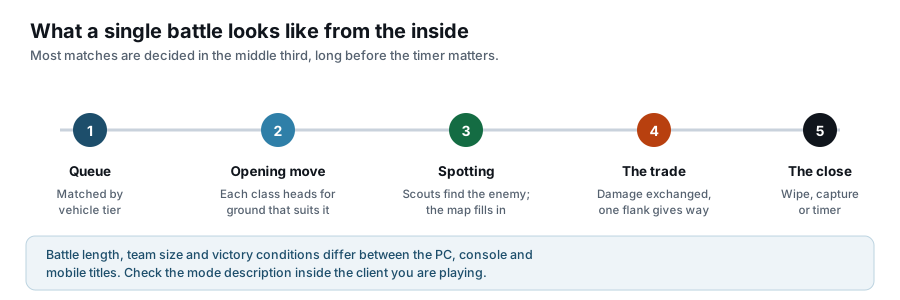
Matchmaking groups players by vehicle tier rather than by skill rating, which means a tier VI vehicle can find itself in a battle alongside tier VIII vehicles. This is deliberate, and it is one of the most consistently criticised parts of the design. When you are the lowest tier in a match your job changes: you stop trying to trade shots and start spotting, supporting and taking secondary objectives.
The five classes and what each is for
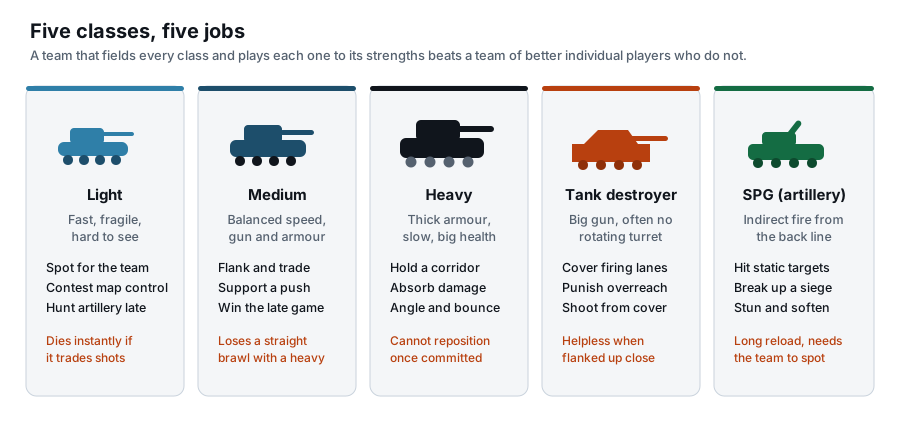
Every vehicle belongs to one of five classes. The classes are not power levels; they are jobs. A team that plays its jobs beats a team of individually better players who all try to do the same thing.
Armour is geometry, not a number
This is the mechanic that confuses every new player. A shell that hits a 100 mm plate does not have to beat 100 mm of steel. It has to beat the amount of steel it travels through, and that depends on the angle at which it arrives.
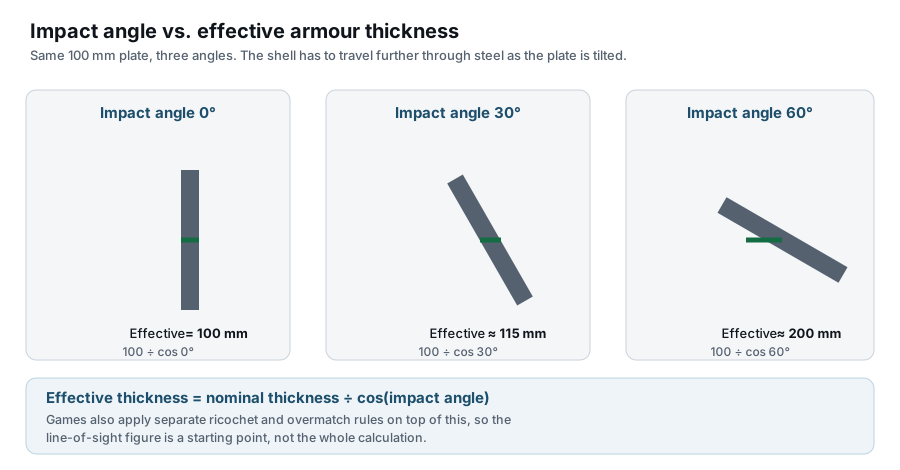
That is why experienced players wiggle their tanks back and forth while reloading. They are not dodging — shells travel far too fast for that. They are presenting their front plate at an angle so that incoming rounds have to chew through more metal. The same trick works in reverse: the way to kill a heavily armoured tank is to get to its side, where the plates are thinner and square to you.
On top of the geometry, the game applies two rules that override it:
- Ricochet. Above a threshold angle an armour-piercing shell skips off entirely and does nothing, regardless of its penetration value. Shaped-charge rounds skip only at far steeper angles.
- Overmatch. If a shell's calibre is large enough relative to the plate — the long-standing rule of thumb on the PC game is three times the plate thickness — it cannot ricochet at all, and it is straightened up towards the plate on impact. This is why very large guns punch through thin, steeply angled roofs and sides that would bounce a smaller gun all day.
Why we are not quoting exact numbers
Ricochet angles, normalisation values and overmatch multipliers have all been adjusted over the years, and they differ between the PC, console and Blitz versions. The shape of the rules is stable; the constants are not. For current figures, use the in-game vehicle statistics screen or Wargaming's own game guide, linked at the bottom of this page.
Shells: three or four buttons, three or four different games
Most guns can load more than one kind of ammunition, and swapping between them mid-battle is a real skill. Loading the round with the biggest penetration number is usually the wrong answer.
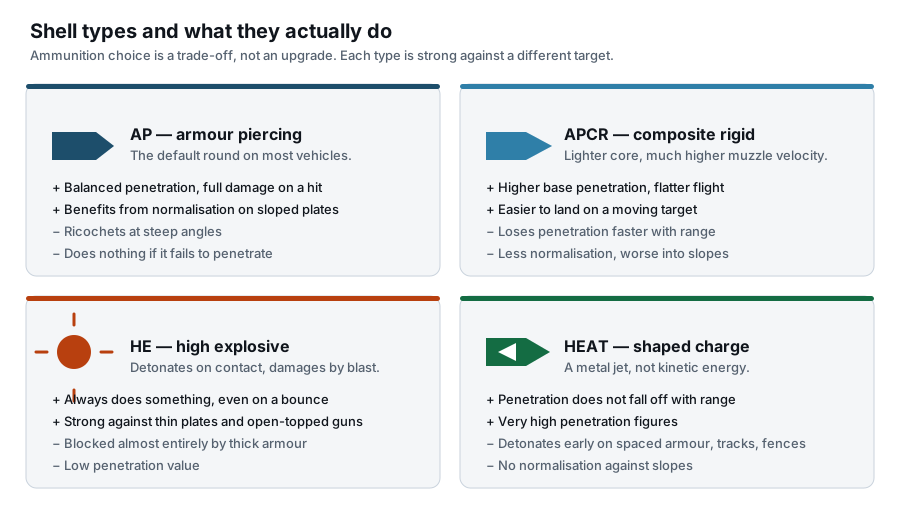
Premium ammunition — the high-penetration rounds — was originally sold for the real-money currency only. Since an economy change more than a decade ago it can be bought with ordinary in-game credits by anyone. It is still expensive in credits, which is the real constraint: firing it every shot at high tier will lose you money over a session.
Spotting: why you get shot by things you cannot see
You do not see the whole battlefield. Each vehicle has a view range, each vehicle has a camouflage value, and an enemy only appears on your screen once somebody on your team detects it. A well-hidden tank destroyer sitting in a bush can shoot at you from a position you have no way of seeing, and the counter is not better reflexes — it is sending a light tank to spot it.
Two consequences follow, and they explain most of what looks unfair on day one:
- There is a hard ceiling on spotting distance on the PC game — 445 metres at the time of writing — regardless of how much view range you stack. Beyond that nothing is spotted, no matter what.
- Firing your gun, and to a lesser extent moving, makes you much easier to detect. Shooting from a bush you were hidden in will often reveal you.
Assists count. The game pays experience and credits for damage that your team does to vehicles you spotted, which is how a light tank that never fires a shot can finish top of the scoreboard.
See how it feels in practice
Spotting mechanics are the hardest part of the game to picture from a description. Twenty minutes in a low-tier light tank explains it better than any article can.
Play World of Tanks freePartner linkPartner link to the World of Tanks offer. If you register through it we may earn a commission from the advertiser; it costs you nothing extra and the game remains free to play. How we are funded
The tech tree and the grind
Progression runs through a tech tree. You start each nation with a low-tier vehicle, earn experience in it, and spend that experience to research the next vehicle along the branch. Researching only unlocks the vehicle; you then have to buy it with credits, and crew it, and equip it.
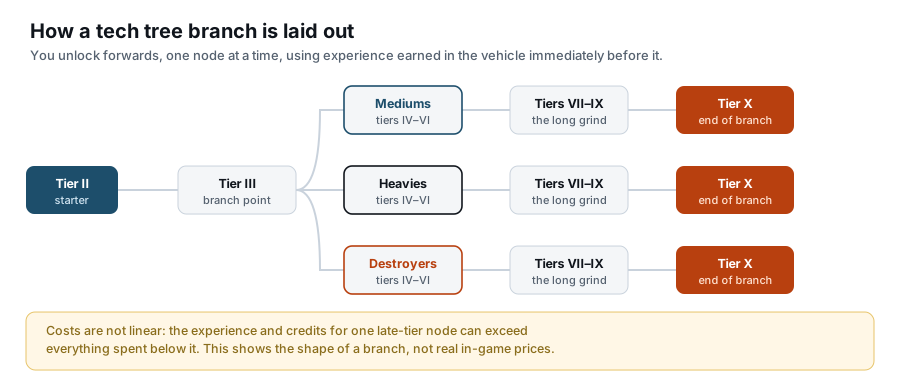
How long a branch takes depends entirely on how much you play and how well you do. Anyone who tells you a specific number of hours is guessing, and so would we be, so we will not. What we can say with confidence is that the top two tiers of any branch take substantially longer than the rest of it combined, and that this is the point at which most players either buy a premium account or stop.
The economy: credits in, credits out
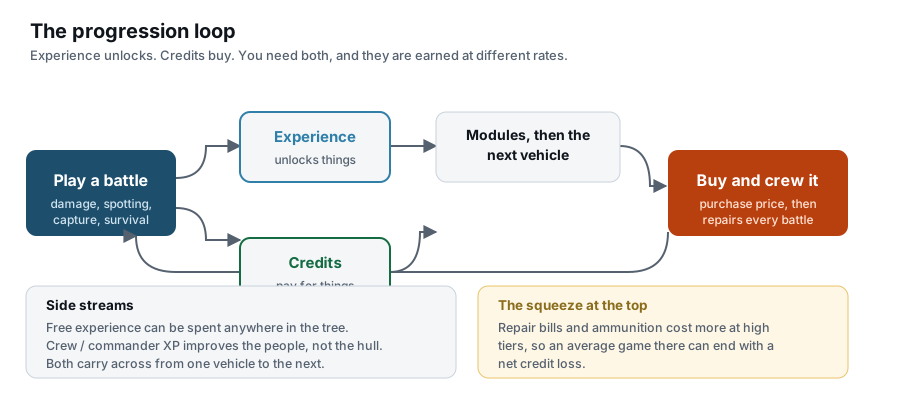
Every battle has running costs. Your vehicle is repaired, your ammunition is replaced, and your consumables are restocked, all from your credit balance. At low and middle tiers these costs are trivial. At tier X an ordinary battle can cost more in repairs and shells than it earns, so players fund their high-tier games by grinding credits in profitable mid-tier vehicles — usually premium ones.
That is the loop the shop is built around, and it is worth understanding before you decide whether to spend anything. We have written it up in detail on what “free to play” actually costs.
Is it pay to win? An honest answer
A second correction
An earlier version of this page claimed the game had “no pay-to-win mechanics” and that “all vehicles and upgrades can be earned through gameplay”. Both statements were too strong, and we have replaced them with the section below.
Here is what is defensible:
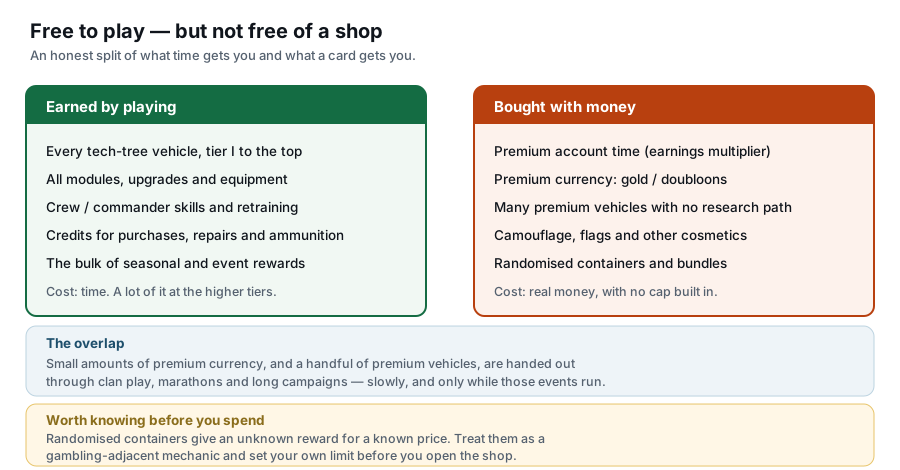
- Every tech-tree vehicle can be earned by playing. There is no tier X you can buy your way to directly, and no upgrade locked behind a paywall.
- Money buys time, reliably. A premium account multiplies credit and experience income. Premium vehicles earn more credits per battle. Boosters and directives stack further. A paying player progresses faster and can afford to play high-tier vehicles more often. That is a real advantage, even if it is not a bigger gun.
- Many premium vehicles cannot be earned at all. A large part of the roster is sold for money or handed out in time-limited events, and once an event closes those vehicles are typically gone. Wargaming's stated intent is that premium vehicles are balanced at or slightly below their tech-tree equivalents, but the player base has disputed that for specific vehicles for years, and several have been re-balanced after release.
- The high-penetration ammunition is not a paywall any more. It costs credits, and credits can be earned.
Our summary: it is not pay-to-win in the sense of buying raw statistical superiority, but it is firmly pay-to-progress, and the economy at the top of the tree is designed to make a premium account feel necessary. Whether that counts as “winning” is a judgement call, and you should make it yourself rather than take ours.
What money buys
Who it is for, and who should skip it
Play it if you enjoy games where positioning matters more than aim, where a match can be won by a decision made in the first thirty seconds, and where there is a genuinely deep mechanical system to learn. It is also unusually good in short sessions: a battle takes a few minutes and you can stop after one.
Skip it if permanent death in a match frustrates you, if you dislike a matchmaker that puts you against higher-tier vehicles, or if you know you will find a long progression grind tedious rather than motivating. It is also a game with a famously blunt community; the chat is easy to switch off and many players do.
Getting started
- Play the tutorial, then stay at tiers III to V for a while. Repair bills are cheap, mistakes are survivable, and the mechanics are the same as at the top.
- Pick one nation and push one branch rather than buying a little of everything. Crews and credits are the bottleneck, not enthusiasm.
- Turn on the server reticle in the settings. It shows where the server thinks you are aiming, which is what actually counts.
- Spend the first few battles learning where you cannot be shot from, rather than trying to get kills.
The beginner's guide goes through this in more detail, including the settings worth changing before your first match.
Ready to try it?
Free client, free account, no purchase needed to reach the tiers where the game is at its best.
Play World of Tanks freePartner linkPartner link to the World of Tanks offer. If you register through it we may earn a commission from the advertiser; it costs you nothing extra and the game remains free to play. How we are funded
Sources and further reading
- Wargaming — World of Tanks official site (Europe): worldoftanks.eu
- Wargaming — official game guide and vehicle wiki: wiki.wargaming.net
- Wargaming — player support and account help: eu.wargaming.net/support
- Wargaming — terms of service, EULA and privacy documents: legal.eu.wargaming.net
- In-game vehicle statistics and the current patch notes inside the game client, which are the authoritative source for any number quoted here.
Published 21 September 2026 by Karen Lee, director of publication. Game mechanics, prices and availability change with every update. Where anything on this page differs from the information published by the game's operator, the operator's own information prevails. Spotted a mistake? Tell us and we will correct it.